
Shine In Layers, Radiate In Light, Celebrate In You
1. Roots: The Legacy of Jewellery in India
Ancient Beginnings
India’s connection to jewellery goes back millennia, when beads, shells, metals, and semi-precious stones were used for both adornment and symbolic significance. The artisans of the Indus Valley Civilization crafted beads and ornaments of carnelian, agate, turquoise, and gold with astonishing precision. IIAD
Over centuries, with the rise and fall of dynasties, influx of foreign influences, and local innovation, jewellery in the subcontinent evolved in complexity, meaning, and technique.
Cultural & Symbolic Resonance
Jewellery in India is never just about beauty—it is deeply social, ritual, and symbolic:
-
Ritual & auspiciousness: Many pieces are tied to religious or life-cycle events (marriage, birth, festivals).
-
Cultural identity: Regional styles, motifs, and materials echo languages, local flora/fauna, and community tradition.
-
Status & heritage: Possessing intricate jewellery often marked royal or elite status; over time, heirloom jewellery became living links to ancestry.
-
Protection & belief: Many communities imbue pieces with protective symbolism (amulets, talismans, sacred motifs).
In modern times, these traditional resonances persist—even as styles shift, the emotional core remains.
The Diverse Styles
India’s jewellery landscape is vast. Some notable styles include:
-
Kundan & Polki – Setting gemstones (often uncut or semi-cut) in gold foil frames; many bridal sets favor this.
-
Meenakari / Enamel work – Bright, colored enamels applied to reverse or surfaces of jewellery, adding vibrant visual contrast.
-
Temple Jewellery – Originating in South India, these pieces often depict deities, temple motifs, and were used for classical dance.
-
Thewa – A rarer art from Rajasthan: gold filigree fused to colored glass, creating intricate and luminous designs.
-
Filigree, granular work, granulation, regional inlays — across states like Odisha, Andhra, Gujarat, these styles bring local character and detail.
Each style is a voice in the grand symphony of Indian decorative art.
2. Crafting the Soul: How Jewellery Comes Alive
To transform raw materials into a piece that feels alive, many phases must align. Let’s walk through the process, emphasizing where “character” is forged.
2.1 Ideation & Design
Every piece begins with a spark. Designers draw from many sources: nature (leaves, petals, waves), architecture (arches, domes, lattice), stories or folklore, or heritage motifs. A sketch (or digital draft) is born, refined, and often repeated in variations.
2.2 Material & Sourcing
Material selection is foundational. Which metal (gold purity, alloy), which gemstone (quality, origin), which supporting elements (pearls, glass, enamel) will be used? Increasingly, ethical sourcing (recycled gold, conflict-free gems) is a priority for both creators and buyers.
2.3 Prototyping & Model Making
Many designs begin with wax or CAD models. This gives a tangible reference to fine-tune proportions, ergonomics, and details. This stage bridges the conceptual with the doable.
2.4 Fabrication & Craft Techniques
This is where the heart is poured:
-
Forging, hammering, shaping: Traditional artisans wield hammers and tools to give form.
-
Stone setting: In styles like Kundan or Polki, stones are placed and secured painstakingly—especially when no glue is used (rather, foil or wires).
-
Enamel / Meenakari work: When color is involved, artisans apply enamel powders or glass pastes, then bake/fuse them with care.
-
Filigree / Granulation: Fine wires and micro beads are used to craft delicate lattice or texture.
-
Finishing & Polishing: Surfaces are smoothed, textures refined, contrasts accentuated (matte vs gloss, oxidized accents, etc).
2.5 Quality, Uniqueness & Human Touch
What differentiates a characterful piece from a massed one is tiny imperfections and artisan choices: a slightly uneven granule, a hand-etched swirl, a subtle texture shift. Those touches—unpredictable but intentional—give soul. No two pieces become exactly the same, even among the “same” model.
3. Color & Texture: The Emotional Palette
Beauty in jewellery is not just in metal and gemstone—but in how color and texture interplay.
Color as Symbol & Mood
-
Gems: Ruby, emerald, sapphire, garnet, and others carry emotional and symbolic tones (royalty, vitality, calm, passion).
-
Enamel hues: Meenakari or enamel adds contrast—turquoise, green, red, blue—to metal surfaces, giving narrative richness.
-
Glass/gem combinations (e.g. Thewa) create luminous contrast with gold over colored backgrounds.
-
Oxidation/antique finishes: Darker tones or patinas add depth, bring out relief, and impart a vintage or heritage feel.
Texture & Relief
Flat, polished surfaces shine beautifully—but contrast is key. Textured surfaces (granulation, filigree, hammered planes) create play of light and shadow. Reliefs (raised motifs) add dimension. Together, they invite touch and intrigue.
Light & Movement
A piece isn’t static. The way gemstone facets catch light, how dangling elements sway, how layered parts overlap—these dynamic factors animate jewellery. Character arises in motion, not just in stillness.
4. Jewellery as Identity & Memory
Even the most exquisite piece remains inert until it becomes part of your life. When worn, jewellery gains meaning.
Milestones & Rituals
Birthdays, weddings, festivals, anniversaries—jewellery often marks these. The first mangalsutra, the heirloom ring, the gift for a milestone birthday—each becomes a reference point in your memory map.
Gifts & Emotional Anchors
A piece given by someone dear, or bought at a meaningful moment (travel, personal achievement), becomes more than metal. It becomes emotional anchor, tied to stories, feelings, and a sense of self.
Heirlooms & Legacy
Passing jewellery across generations transfers not just the object, but the narrative: who wore it, in what era, the story behind it. The heirloom is living memory, binding past, present, and future.
Identity & Style Signature
Many people develop a jewellery “signature” (a motif, metal tone, or form) that becomes part of how they present themselves. Jewellery becomes a language of identity.
5. Tradition Meets Innovation: Contemporary Shifts
While deeply rooted, jewellery is evolving—its future marrying tradition to innovation.
Lightweight Designs & Cost Sensitivity
With gold prices rising, buyers are gravitating toward lighter constructions or lower-carat gold (e.g. 18k vs 22k) to stay in budget without sacrificing aesthetics.
Designers are innovating to preserve traditional patterns but reduce weight—hollow segments, filigree, minimal backing, smart structure.
Ethical & Sustainable Practices
Consumers increasingly ask: Where did this gemstone come from? Is the gold recycled? Are artisans fairly compensated? Brands that provide transparency and sustainability have stronger resonance.
Technology + Craft Hybrids
CAD, 3D printing, laser cutting, and engraving now assist artisans—not replace them. This allows precision, prototyping, and structural support, yet leaves room for hand-finishing and individuality.
Research also explores AI-based design generation in handicrafts, offering novel pattern suggestions rooted in tradition.
Fusion & Versatility
Modern wearers often need jewellery that transitions from day to evening, from traditional wear to fusion outfits. Thus minimalist forms, convertible pieces (detachable parts), mixed metals, and modular designs are gaining popularity.
Revival of Forgotten Crafts
Some techniques, nearly lost, are being revived: Thewa (in Rajasthan) is a notable example of a niche craft being brought back to vibrancy.
Heritage branding is also powerful—telling the story of the region, the artisans, the lineage behind each piece draws emotional connection.
6. How to Choose Jewellery That Speaks to You
Here’s a methodical yet emotional guide to choosing pieces that feel like “you.”
Step 1: Listen to Your Instincts
When you see a piece and feel drawn, pause—why? The motif, the color, the texture, the memory it evokes.
Step 2: Check Craft & Integrity
-
Are the gems securely set?
-
Is the finish clean, edges smooth?
-
Does the clasp, hinge, link feel solid?
-
Are materials disclosed (metal purity, gemstone details, certificates)?
Character without structural integrity falters.
Step 3: Wearability & Comfort
A heavy or awkward piece may remain rarely worn. Consider weight, balance, how it sits on your neckline, wrist, ears.
Step 4: Versatility & Layering
Choose pieces that can layer or pair: necklaces of different lengths, mixable metals, detachable parts. This extends wear and expressive potential.
Step 5: Emotional Value > Trend
Trends fade; a piece that aligns with your soul—and not just the moment—often becomes timeless in your wardrobe.
7. Caring for Jewellery: Preserving Its Spirit
Even the finest piece requires care to maintain its luster, structural integrity, and emotional vitality.
Storage
Use soft pouches, lined boxes, compartments. Separate pieces with stones or enamel to prevent scratches.
Cleaning
Gentle cleaning: mild soap, soft brush, warm water. Avoid harsh chemicals, ultrasonic cleaners (especially for enamel, delicate stones). Dry thoroughly.
Inspections & Repairs
Periodically check prongs, clasps, links. At first sign of wear, get professional servicing. Re-plating or re-finishing may be required over time.
Handling & Wear Habits
Remove jewellery during chores, sports, swimming, applying lotions or perfumes. Handle with clean, dry hands. Avoid shock or impact.
Document the Story
Record the origin, artisan, date of purchase, and sentiment. This documentation adds emotional and heritage value when you pass it on.
8. Legacy & Passing It On
Jewellery becomes truly timeless when passed forward.
-
Engraving / Personalized marks: A date, initials, message can tie a piece to memory.
-
Story sharing: When passing the piece, share its story: who made it, why it was chosen, what it has seen.
-
Restoration over replacement: When a treasured piece wears, restore rather than discard.
-
Reworking / adaption: Sometimes elements from an old piece (gems, metals) can be reinterpreted into new designs—preserving legacy in new form.
In this way, a piece becomes living heritage.
9. Closing Reflections
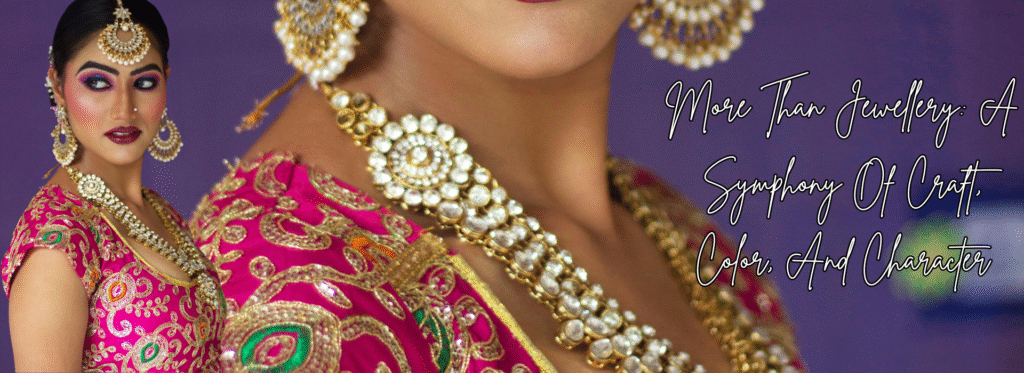
The necklace in your image—the lush gold, the kundan work, the delicate interplay of gem and metal—is more than sumptuous ornament; it is a visual promise: that craft, color, and character can converge into something that speaks. That bridges culture, emotion, and personal identity.
When you wear jewellery that’s sculpted with soul—imbued with story, made with integrity—you carry more than metal and stone. You carry legacy, passion, the invisible hands that shaped it, and meaning that deepens with time. May your next piece not only adorn you — but echo through years, telling a story uniquely yours.