
More Than Jewellery: A Symphony Of Craft, Color, And Character
More Than Jewellery: A Symphony Of Craft, Color, And Character
Jewellery is often seen as adornment, a finishing touch, or a symbol of status. But truly exceptional pieces transcend their material form. They become stories in gold and gem, memories cast in metal, echoes of hands that shaped them. In this blog, we step beyond the sparkle to explore the soul of jewellery — how craft, color, and character come together to make something far richer than just ornamentation.
1. A Glimpse at the Image: What Speaks to Us
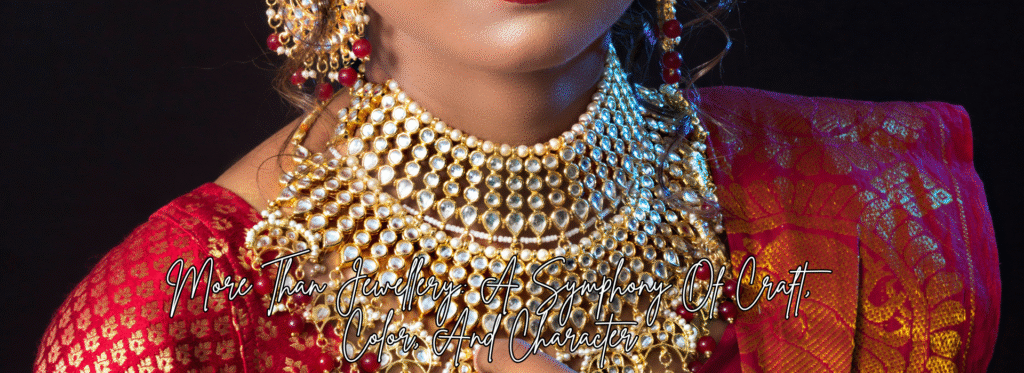
Before we dive deep, let’s pause over the image that inspired this piece. The photograph captures a lavish neckpiece of gold and kundan or polki work, set against bold traditional attire. The richness of color, the intricate design, the nuanced reflections — everything communicates more than wealth. It speaks of heritage, of diligence, of legacy. That visual becomes our portal: we want to trace how such pieces go from artisan’s vision to your heart.
2. Roots & Resonance: The Cultural Tapestry
The Ancient Beginnings
Jewellery in India is not a recent accessory. It’s deeply embedded in history, culture, and belief. Excavations from the Indus Valley Civilization (circa 3300–1300 BCE) reveal beads, bangles, and ornaments made of gold, copper, semi-precious stones, shells, and faience. IIAD+2IIG South+2
Over centuries, as kingdoms formed and artistic traditions flourished, jewellery evolved — not just in technique, but in meaning. It became integral to religious rituals, royal identities, and cultural symbolism. IIAD+2Kunal Jewelers+2
Craftsmanship & Regional Styles
India’s vastness houses countless jewellery traditions — each region with its own motifs, methods, and stories.
Kundan / Polki: The method of embedding uncut gems or polished stones into gold foil is a hallmark of regal adornment. Wikipedia
Temple jewellery: In South India, pieces initially crafted for deities found a second life in bridal sets and classical dance. The Nagercoil temple jewellery is a recognized example. Wikipedia
Meenakari / enamel work: Vivid colors on metal surfaces add an expressive dimension beyond just material shine. Tarinika+1
Thewa: In Rajasthan, thewa art fuses fine gold sheet designs onto multicolored glass — a delicate, labor-intensive craft. Wikipedia
And many more: filigree, granulation, granada inlay, scrollwork, alloy innovations — the palette is wide.
Each style is more than a technique; it’s a voice. A voice that says: this land, this family, this culture.
3. The Craft: From Vision to Wearable Art
To create a piece that carries character, multiple steps — each demanding care — must harmonize.
3.1 Design & Inspiration
Everything begins in the mind’s eye. Designers may draw from nature (flora, vines, animals), architecture (temples, domes, arches), folklore, regional motifs, or personal stories. Sketches evolve, motifs repeat, and a visual vocabulary forms.
3.2 Material Selection
Choosing the right metal, purity, stones, and supporting materials is critical. Ethical sourcing (recycled gold, conflict-free gems) is increasingly important to many customers.
3.3 Prototyping & Modeling
Some pieces begin as wax models; others are hand-forged metal skeletons. CAD and 3D modeling tools are now used alongside traditional methods, enabling precision and experimentation.
3.4 Fabrication & Assembly
Forging / Hammering: Many traditional pieces are forged by hand, giving them subtleties that machines cannot replicate.
Stone Setting: Whether in Kundan, polki, or gem settings, placing each stone correctly requires dexterity, alignment, and acute attention.
Enamel / Coloring: Where color is involved (like Meenakari or thewa), artisans delicately apply enamel powders or glass, then bake or fuse carefully.
Polishing & Finishing: Finally, surfaces are refined — brushed, high-gloss, oxidized accents — to create depth and contrast.
3.5 Quality & Uniqueness
A piece that shows signs of thoughtful finishing, secure settings, precise symmetry (or deliberate asymmetry) — these define character. Also, no two handcrafted pieces end up perfectly identical, and that slight variation is part of the charm.
4. Color, Texture & Emotion
Color is not just aesthetic — it’s symbolic. Gemstones, enamel hues, metal finishes carry emotional, spiritual, and design weight.
A deep ruby or garnet may evoke passion or royalty.
Emerald or green stones may suggest renewal, fertility.
Enamel blues and greens often connote serenity, nature, water.
Oxidized silver or antique gold finishes can bring vintage warmth, nostalgia.
Textures — from matte detours to fine granulation, to crisp faceted edges — add tactile life.
Emotion lives in how a piece feels: against the skin, how it swings, how the light catches it, how weight is balanced. That is where character reveals itself.
5. Jewellery as Narrative — Memory, Identity & Legacy
Once you wear jewellery, it becomes entwined with your story:
Milestones & Celebrations: Weddings, birthdays, coming-of-age rites become inseparable from the pieces worn.
Gifts & Intent: When someone gives jewellery, they give more than gold—they give a sentiment. That makes the piece intimate.
Heirlooms: Pieces passed down carry not only metals and gems but memories, names, histories.
Self-expression: For many, jewellery is identity. It says something about tastes, roots, personality.
When a customer chooses a piece — it’s not just a transaction. It’s the moment a story begins or continues.
6. Modern Challenges & Innovations
The jewellery world is not untouched by time. It meets pressures and opportunity.
6.1 Economic & Material Pressures
Rising prices of gold have pushed some buyers towards lighter designs or lower-carat gold. Reuters Some artisans struggle; in parts of Tamil Nadu, goldsmiths have left traditional work due to shrinking demand and soaring costs. The Times of India
6.2 Ethical & Sustainable Futures
Buyers increasingly demand eco-conscious practices: sourcing recycled metal, ethical stones, minimal waste, and fair artisan remuneration.
6.3 Technology & Hybridity
CAD, 3D printing, laser engraving now assist artisans. Some designs begin digitally and then are realized by hand. AI has also been explored as a tool to generate design inspiration in handicraft sectors. arXiv
This hybridization — technology as enabler, not replacer — can help preserve tradition while staying contemporary.
6.4 Revival & Heritage Marketing
Many brands emphasize the heritage behind each piece. Stories of artisans, regional techniques (like thewa, temple gold, Nagercoil pieces), and cultural lineage help the jewellery stand out. The regional exclusivity (like Nagercoil jewellery’s GI status) adds value. Wikipedia
7. How to Choose Pieces That Resonate
To find jewellery that truly carries soul, here are guiding principles:
Connect with the story
Does the piece reference a tradition, motif, or artisan? Ask: who made it, where, which tradition?Comfort & Wearability
Even the most beautiful piece must feel right — weight, balance, edges, clasp comfort.Versatility
Can it be layered, paired, taken from day to night, fused with modern wear?Quality & Integrity
Inspect settings, finishes, symmetry. Authentic hallmarks, certifications, artisan notes matter.Emotion over trend
Trends fade; a piece that speaks to you personally holds stronger.
8. Care, Maintenance & Preservation
Jewellery is living in usage — to retain its character, care is vital.
Store in soft cloth, separate compartments, avoid scratches.
Clean gently — mild soap, soft brush; avoid harsh chemicals, especially for enamel.
Periodically check prongs, settings, clasps.
Professional servicing or re-plating may be required over time.
Document its history: artisan name, when bought, story behind it — this increases emotional value for future generations.
9. The Future of Soulful Jewellery
As we move forward, what will “jewellery with soul” mean?
Inclusivity of design: Breaking away from purely bridal or traditional expectations, offering expressive and daily wear pieces.
Sustainable luxury: Recycled metals, conflict-free stones, transparent practices becoming baseline.
Story-led commerce: Brands that center artisan stories, local techniques, and customer connection will resonate more.
Collaborative craft: Technology and craft partnering, not replacing — preserving human touch.
Community & legacy: More people seeing jewellery not just as object, but as cultural bridge between past and future.
10. Closing Thoughts
The piece in your view — the necklace in the photo — is more than a statement of opulence. It is a frozen moment of countless decisions: design, motivation, artisanship, color, finish, emotion. That is the symphony: craft, color, character.
When you wear jewellery crafted with respect for tradition and heart in design, you become a part of its story. You carry forward its legacy.
May your next piece you choose not just catch light — but touch your heart.